Energy-efficient renovation of your own home: Research project shows need for information and helps with online guide
Berlin, 15 December 2025 | It is difficult for homeowners to get an overview of the topic of energy-efficient building renovation. There is a lack of information, especially with regard to suitable heating technologies, subsidy conditions and legal obligations. This is shown by the “building-dialogue” research project, funded by the German Federal Ministry for Economic Affairs and Energy (BMWE). With the online tool Building Dialogue, the project team has developed a guide that is freely available and with which homeowners can obtain independent information without prior knowledge. Researchers from the Reiner Lemoine Institute (RLI), the Institute for Ecological Economy Research (IÖW), the Independent Institute for Environmental Issues (UfU) and the German Solar Energy Society Berlin Brandenburg (DGS) worked together on the project.
New heating, a new roof or thermal insulation – there are many measures and suitable funding programmes for the energy-efficient renovation of residential buildings. In the building-dialogue research project, experts investigated the obstacles and hurdles that private homeowners, homeowners’ associations (WEGs) and housing companies experience when it comes to energy-efficient renovations and how their need for information and attitudes shape their willingness to renovate. The researchers also looked at the value-added effects that renovation measures can have on municipalities.
“We have found that a lack of orientation for suitable renovation measures, uncertainties due to financial burdens and technical acceptance, for example of new technologies such as heat pumps, act as central obstacles to renovation measures,” says Marie-Claire Gering, researcher and project manager at RLI.
Online guide shows measures, funding and value creation
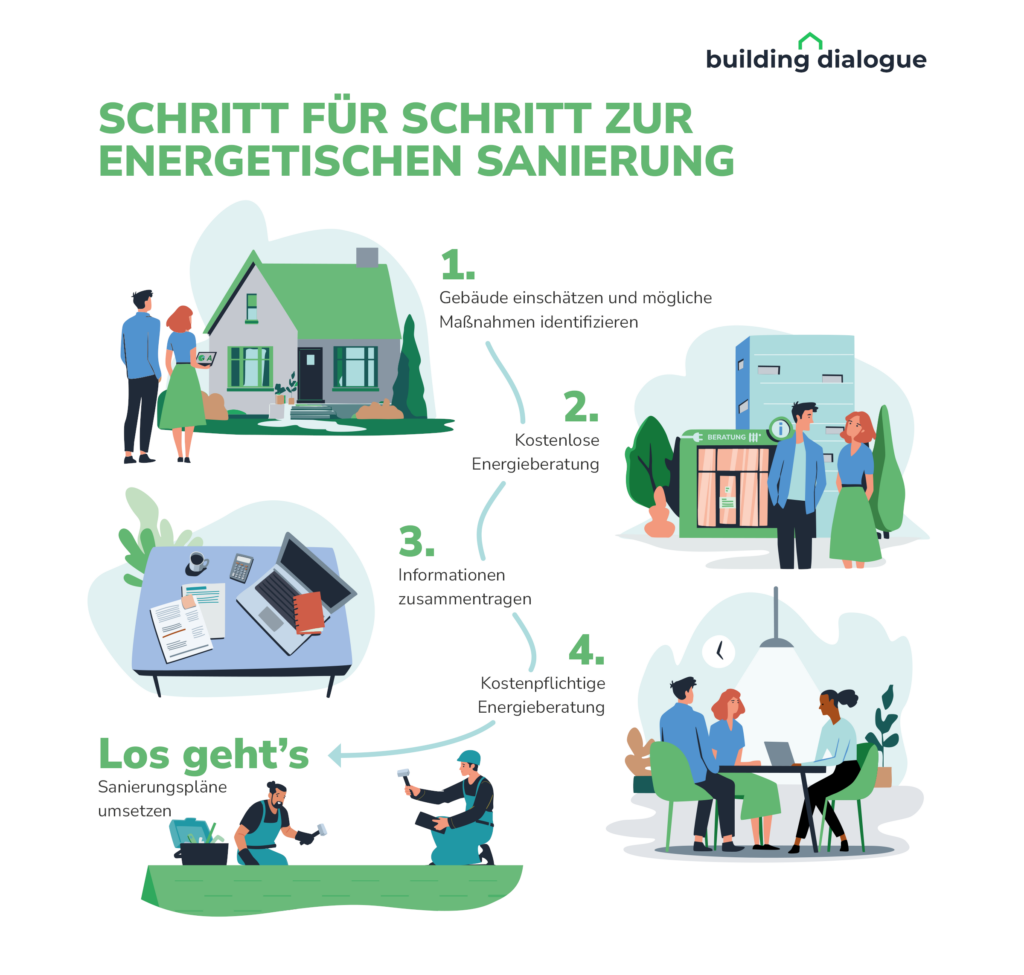
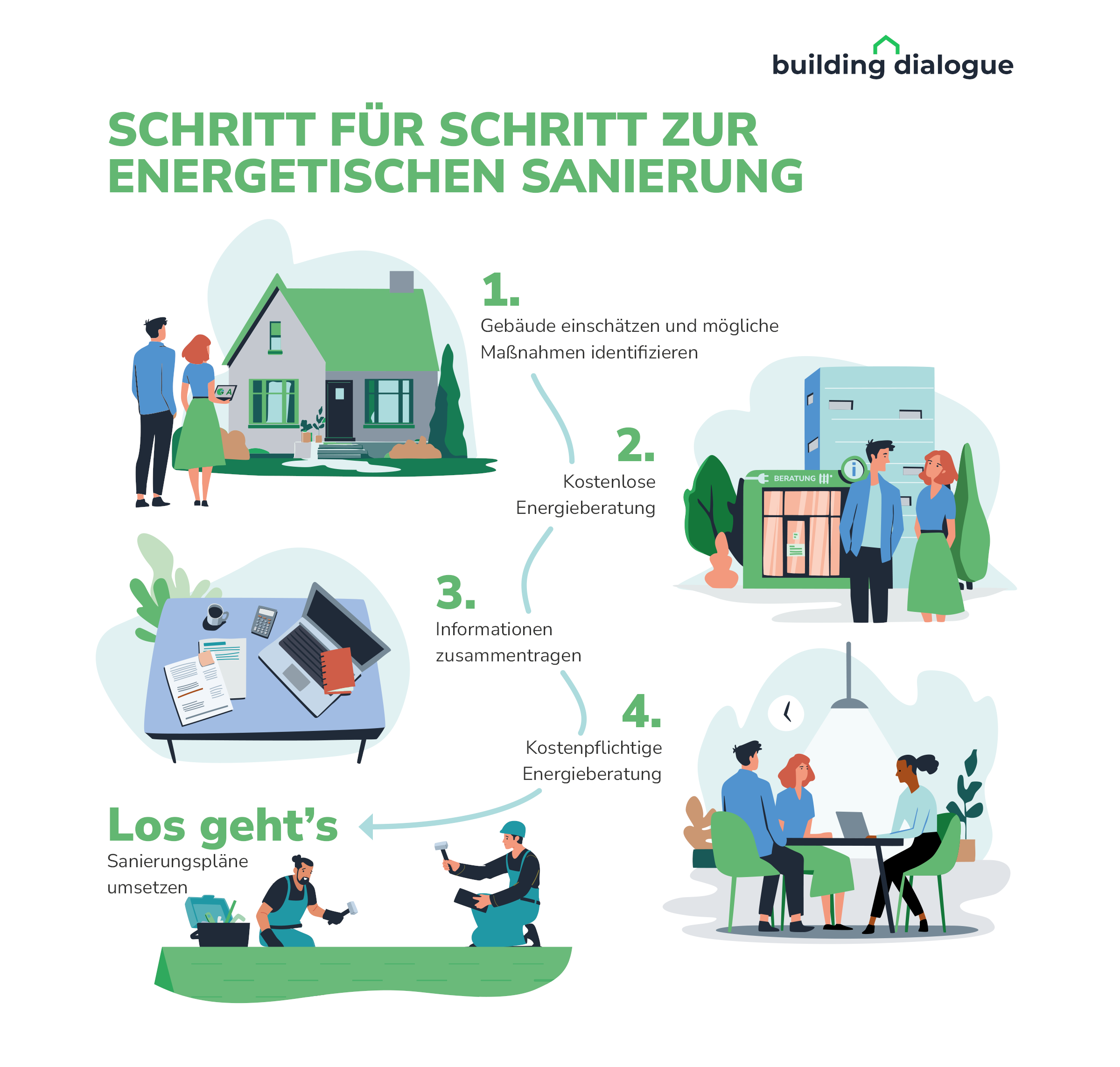
Based on their findings, the experts have developed an online guide. Users receive step-by-step instructions that help them with energy-efficient renovation and provide access to understandable information on the topics of modernization options, heating system replacement, subsidy programs and legal matters.
The Wegweiser is an online tool that supports owners in assessing the initial condition of their building as well as their individual renovation needs. It provides easy-to-understand knowledge on the energetic building renovation and shows free consulting services and other tools. “Users can use it to go to an energy consultation optimally prepared, do something for their property and the energy transition and, in the best case, save money,” says Gering.
Renovation promotes value creation in the municipalities
Energy-efficient renovation measures can also mean added value and employment for regional companies and thus tax revenues for municipalities. If around 20 buildings are renovated in a municipality with 2000 buildings, which corresponds to a renovation rate of one percent, an annual added value of over 380,000 euros can be created in the regional economic cycle. This can lead to municipal revenues of around 26,000 euros per year. Interested parties, such as employees in municipal administrations, can also find information on this in the guide.
Need for understandable and practical information
In the project, the scientists analysed the needs of different groups and conducted qualitative interviews with multipliers, energy consultants and decision-makers. The results show that while professional actors such as housing companies and energy consultants have extensive knowledge and resources, there are deficits among private owners and condominiums.
The analysis shows the need of these groups for understandable, practical information that includes implementation steps as well as stumbling blocks and decision-making options. Questions of budget optimization, orientation to technology combinations and the integration of regional peculiarities are in the foreground. The online tool addresses these needs directly and thus supports stakeholders in the planning and implementation of energy-efficient building renovations in order to further implement the heating transition.
Material
- Building Dialogue guide: https://building-dialogue.rl-institut.de/
- Graphic: https://reiner-lemoine-institut.de/wp-content/uploads/2025/12/Pressegrafik_building-dialogue_2025__Illustrationen-B-Sturm-und-B-Lancien.png
- Image source: Building Dialogue 2025, with illustrations by B. Sturm and B. Lancien
- Suggested caption:
Online calculation tools for energy requirements and professional advice help homeowners find suitable renovation measures and subsidies.
Further information
About the building-dialogue project: The project is funded under the funding priority “Energy Transition and Society” as part of the BMWE’s energy research programme and will run from October 2023 to December 2025. To this end, innovative dialogue formats have been developed – for the transfer of information, consultation and increasing acceptance. This is accompanied by the present Building Dialogue tool. With the tool and the dialogue formats, multipliers such as energy agencies can approach building owners in a targeted manner. In addition to topic-based knowledge compilations and link collections, practical support tools include a specially developed brochure and a poster intended to encourage building owners to take their first steps on their own and also to consult professional advice.
The goal of the non-profit German Society for Solar Energy Berlin Brandenburg (DGS) is a sustainable energy supply with 100 percent renewable energies. To this end , it works in research projects, offers professional training and technical services, produces specialist books, carries out standards and committee work and provides individual advice on the use of solar energy. www.dgs-berlin.de
The Institute for Ecological Economy Research (IÖW) is a leading scientific and non-profit institute in the field of practice-oriented sustainability research. In transdisciplinary projects, the independent institute develops strategies and approaches for a sustainable economy – for an economy that enables a good life and preserves the natural foundations. www.ioew.de
The Reiner Lemoine Institute (RLI) is an independent, non-profit research institute that has been committed to a future with 100 percent renewable energies since 2010. In the three research areas Transformation of Energy Systems, Mobility with Renewable Energies and Off-Grid Systems, the scientists work in an application-oriented and scientific manner for the energy and transport transition in Germany and internationally. www.reiner-lemoine-institut.de
The Independent Institute for Environmental Issues (UfU) is a scientific institute and a non-profit citizens’ organisation with the aim of analysing and promoting environmental policy development in a citizen-oriented and time-critical manner. Since 1990, the institute has been working in particular on the promotion of democracy and education in environmental and resource conservation. www.ufu.de
Contact project management:
Marie-Claire Gering
Reiner Lemoine Institute
Researcher
Transformation of Energy Systems
marie-claire.gering@rl-institut.de
Press:
Timo Beyer
Reiner Lemoine Institute
Communication
030 12084 3415
presse@rl-institut.de
