EnDev – Knowledge Continuity for Energising Development

Project description
The EnDev program run by the Deutsche Gesellschaft für Internationale Zusammenarbeit (GIZ) is an international partnership promoting access to energy in the Global South. It has around two decades of experience in international energy cooperation. EnDev is currently being converted to a regionalized structure. This carries the risk of knowledge becoming fragmented and inconsistent and dependent on a limited number of individuals. Together with project partner Enerpirica, RLI researchers are systematically collecting this knowledge and preparing it in such a way that it remains available to EnDev employees and decision-makers. The goal is to build a sustainable knowledge ecosystem, the Knowledge Hub, which captures, structures, and makes knowledge accessible to support learning, decision-making, and long-term institutional memory.
Knowledge ecosystem: Knowledge Hub
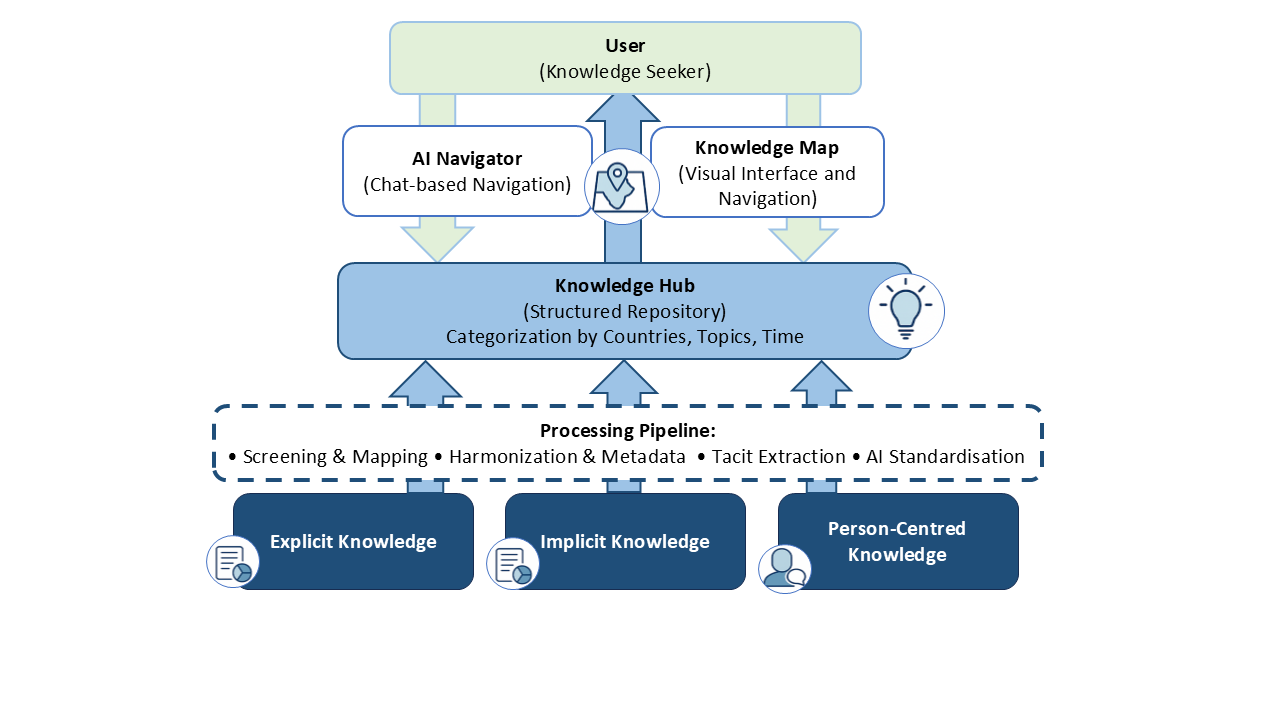
The Knowledge Hub is being set up as a structured, searchable knowledge repository with a dual architecture: On the one hand, an internal Knowledge Hub is being created for GIZ, including an internal, AI-supported chatbot, into which implicit knowledge and unpublished documents are also fed. Secondly, an external chatbot will be provided that accesses only explicit or published content and is accessible to the general public. Both access points are based on a visual overview in the form of a knowledge map and chat-based navigation functions. To this end, the researchers are developing a uniform taxonomy and semantic rules that can be applied across products so that the AI-supported systems can provide consistent, comprehensible, and explainable answers.
Implementation of knowledge continuity
Explicit, implicit, and personal knowledge flows into the Knowledge Hub through a processing pipeline. It is stored in a structured repository, a central digital storage location that is categorized by country, topic, and time. Implementation initially involves standardizing knowledge structures, e.g., templates, terminology, and metadata, which are entered into the Knowledge Map and Hub. To avoid dependence on personal knowledge, semi-structured interviews with experts and group discussions are conducted and their results are summarized in the form of standardized knowledge capsules. These can then be reused in different regions and future program phases.
Project period: January 2026 – September 2026
Tasks
- Creation of the sustainable knowledge ecosystem Knowledge Hub
- Creation of a visual knowledge map
- Development of an AI-powered navigator
- Reduction of personal knowledge through interviews and summary in standardized knowledge capsules
Funding
Partners